
Cracking codes at scale in Revolut
People · Talent programmes · December 4, 2025Eleanor Taylor
The International Collegiate Programming Contest (ICPC) brings together the world’s brightest students to solve complex, real-world problems under pressure — showcasing teamwork, creativity, and innovation at the highest level.
Ahead of Revolut’s sponsorship of the 2025 ICPC Northern Eurasia Finals, Kazakhstan, the 2025 ICPC Asia-East Continent Final Contest, and the 2026 ICPC Europe Championship, we spoke with Revoluters who are proud ICPC alumni about how the contest shaped their careers.

Why is Revolut a great place for ICPC competitors to launch their careers?
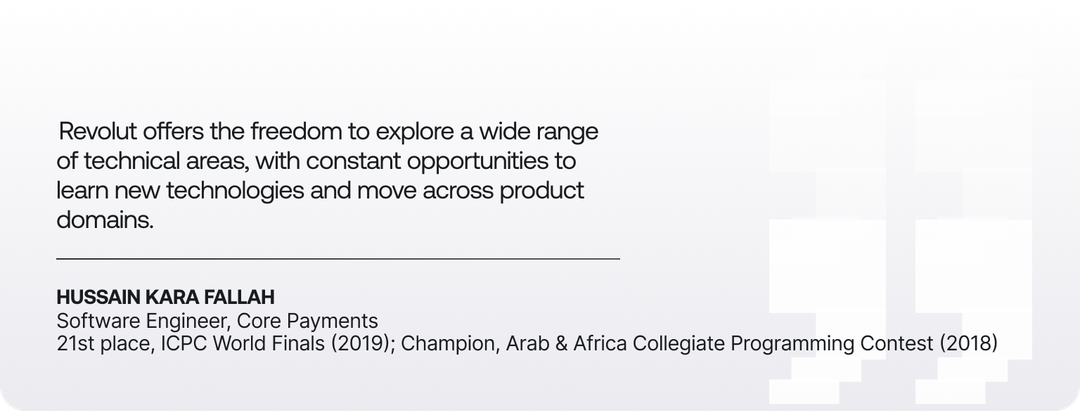
Hussain Kara Fallah: Revolut is the fastest-growing fintech in Europe, delivering real impact at a global scale. It’s an exciting place for engineers who want to work on a product they use every day and see their work make a real difference.
Every project comes with unique trade-offs, constraints, and challenges, allowing engineers to grow by approaching each problem with a fresh perspective.
What makes working at Revolut particularly challenging?
Hussain Kara Fallah: I work on Revolut’s Core Payments Platform team, improving and scaling the systems that connect Revolut with banks and payment providers worldwide. The most challenging part is adapting quickly as the product grows — making decisions on the go, solving scalability issues, and updating systems built on old assumptions.
When new requirements arise, we need to find efficient solutions that meet tight deadlines with minimal compromises, carefully balancing speed, stability, and long-term maintainability. Product teams move faster than platform teams, so our engineers start from analytics and metrics to identify the biggest problems to solve and focus on the areas where we can deliver the most impact.
What was the most rewarding part of competing in the ICPC?
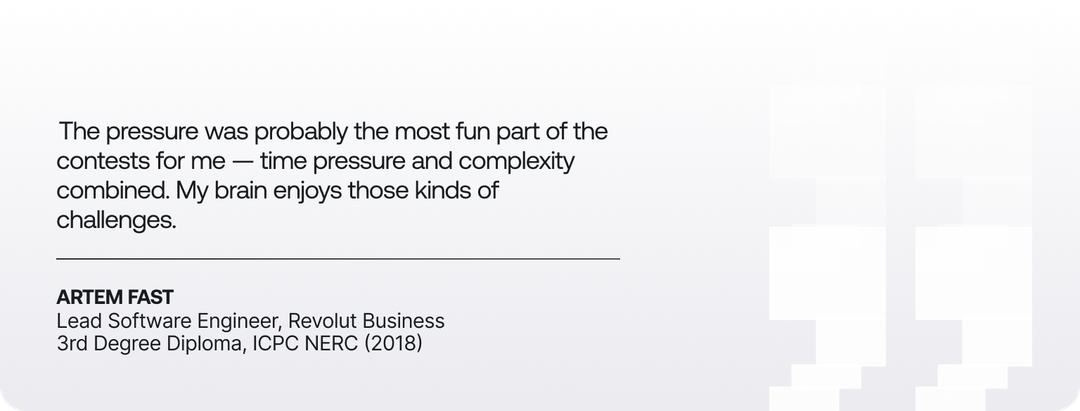
Artem Fast: There are two main skills I gained from my ICPC experience that I use regularly today.
The first is rapid incident response: the ability to search for a variety of potential causes in both known and unknown places during a production incident. Just like in the ICPC, every second counts, and solutions need to be quick and precise.
The second is mathematical rigour: whenever a problem needs solving, my mind instantly jumps to all the edge cases to consider, making sure the solution fits reality and is also future-proof.
There are other skills too, but for me these two stand out the most.
How did competitive programming sharpen your problem-analysis skills?
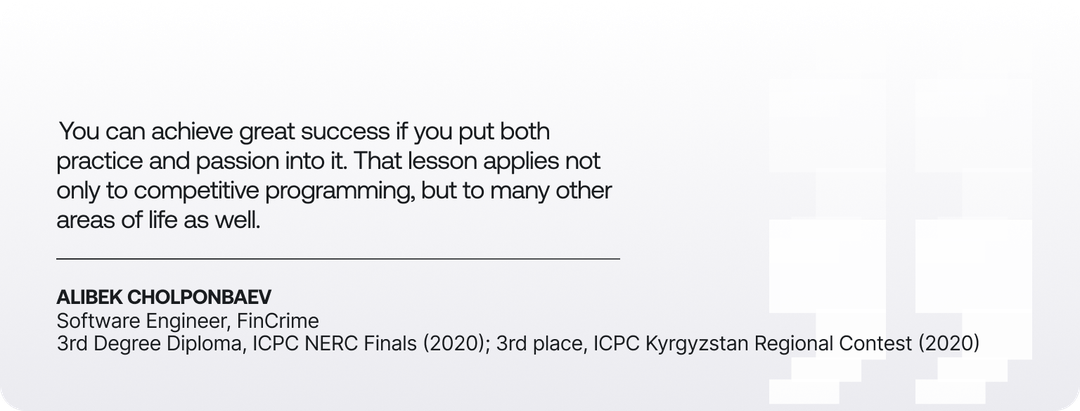
Alibek Cholponbaev: Competing in the ICPC taught me a lot about problem-solving.
The most useful skill was being able to isolate the most important parts of a problem and map patterns to ones I had practiced before. Seemingly unrelated problems can share underlying ideas and patterns if you abstract away from the small details.
What insight from competing has had the greatest impact on you?

Sum up the ICPC in one word.
Egor Iastrebov: Exhilarating.
How does your competition experience show up in your work?
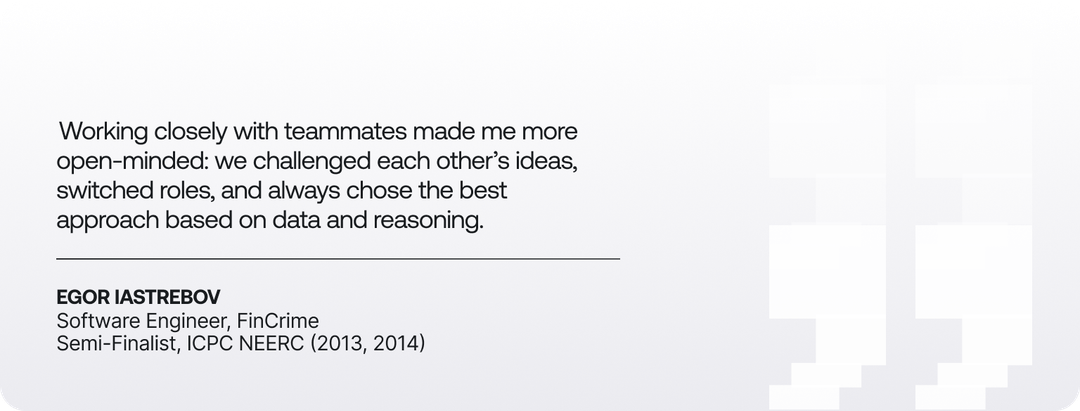
Egor Iastrebov: Revolut’s Think Deeper culture resonates strongly with my ICPC experience. The problems I solved competing in the ICPC taught me to read between the lines, uncover hidden constraints, and be creative in overcoming challenges — all while keeping the code simple and reliable.
We also thought long-term during contests: choosing the right problem order, writing small reusable code, and adding quick ad-hoc tests to avoid issues later.
How did competitive programming teach you to build more resilient solutions?
Ibrakhim Ilyassov: In the ICPC, every problem had to be solved completely, with all edge cases covered — otherwise the solution didn’t count. The competition taught me to think more deeply, anticipate failure scenarios, and ensure solutions are thorough and resilient.
What did competing teach you about teamwork?
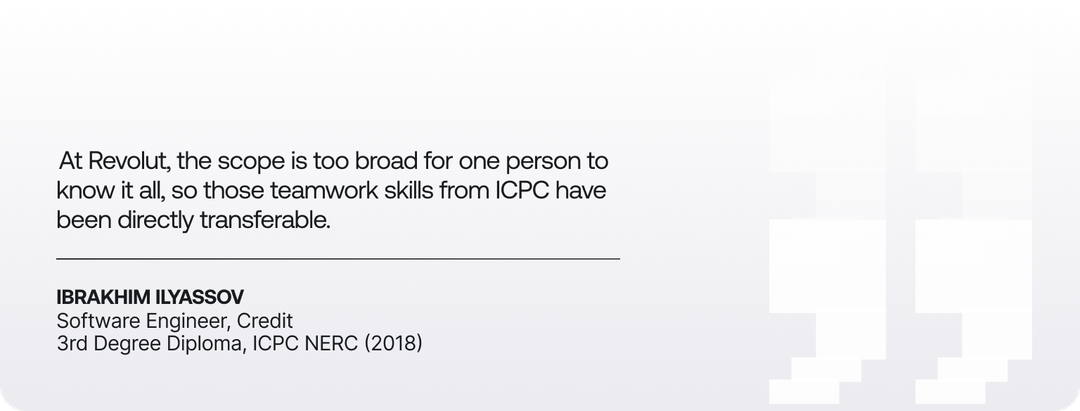
Ibrakhim Ilyassov: Being efficient with resources was crucial when I competed in the ICPC. We learned each other’s strengths and weaknesses and divided problems accordingly. When challenges required combined knowledge — like dynamic programming plus combinatorics — we worked together.
As our ICPC alumni show, the skills developed through elite programming competitions, from collaboration and creativity to solving complex problems under pressure, are exactly what it takes to thrive at Revolut.
Ready to take the next step alongside a community of STEM champions?
Accelerate your career with our Rev-celerator Programmes, where ambition meets opportunity.